
The Technical University of Madrid (UPM) celebrated its 25th anniversary in 1996, although the majority of its centres are over hundreds of years old and were founded in the 18th and 19th centuries. Each of them maintained its independence until being grouped together to form the UPM. It is no exaggeration to state that over one and a half centuries great part of the history of Spanish technology has been written by the Schools of Architecture and Engineering. They have been during a lot of years nearly the only and in some cases actually the only schools. All of the important personalities in the area of teaching and research passed through the respective centres as students or lecturers.
One of the oldest records of technological studies in Spain is the Royal Academy of Mathematics in Madrid, leaving aside the Quatrivium of arithmetics, geometry, astronomy and music, the four liberal arts, that form the base of the technical disciplines, which were studied in the monastic and cathedral schools and later in the medieval and renaissance universities. The Royal Academy of Mathematics was created after the idea and personal initiative of King Philip II after his return from a visit to Portugal in 1582, where he realised that the Portuguese cartographers were more advanced than those in Spain. The Academy did not award qualifications that entitled to exercise a profession. Its prestige was based on the lecturers and subjects taught. Cartographers, pilots, architects and engineers were trained in a way that the latter two started to gain a certain degree of recognition. In 1643 the Academy was closed down. The second relevant record of technological studies was the Body of Army, Cities, Ports and Frontiers Engineers founded by King Philip V in 1711. This date marked the foundation of the Spanish engineers as an organised profession. In 1716, for their training, the Royal Military School of Mathematics in Barcelona was created, even if it was not opened until 1720 and besides was limited to a strictly military context.
Among all the subjects that nowadays form part of the Technical University of Madrid, the first to start specific and concrete lectures and not in a generalised manner, as it was the case of engineering that started with a military background, was architecture, years before the School and the Academy of Fine Arts were created. The Foundation Assembly of the Royal Academy of the Three Noble Arts of Saint Ferdinand was held on 18.07.1744 in the home of G.D. Olivieri, first sculptor to the king since 1741 where he had a private academy and its studies prepared the way for the ones that where officially regulated in the assembly. Twelve lecturers, four for each subject where appointed. The classes of the new School that depended on the Academy of Fine Arts started in the Casa de la Panadería in the Plaza Mayor of Madrid and continued there until 1773 when the Academy moved to its present building.

Although the Special School of Fine Arts was founded in 1845 as an independent entity, it was at the beginning under the inspection and monitoring of the Academy. At present the Higher Technical School of Architecture is located in a modern building in the Ciudad Universitaria in Madrid. King Charles III ordered on 13.08.1772 the foundation of the School of Naval Engineering for the training of the future members of the Body of Marine Engineers (24.12.1770). The academy was opened in El Ferrol. After several years of teaching a series of difficulties led to the closure of the centre. French naval engineers were taken on after intense negotiations and the centre was reopened in the Arsenal de la Carraca in Cadiz in 1848. Today's School of Naval Engineers, located in the Ciudad Universitaria, is one out of two UPM schools that started with a military background and is completely civil nowadays. Several years later the same happened in the School of Aeronautics.
The School of Mining Engineering was the first that from the day of its foundation had a civil character. It was established in 1777 by the orders of King Charles III in Almadén, Ciudad Real, where already some type of informal teaching existed, in order to make use of a very important element: the mercury mines. Mercury was in those days an irreplaceable material for the amalgamation of silver, which was one of the key sources of wealth in Latin America, especially in Mexico. This School started its activities in a similar historical context to that of other centres such as those in Saxony (Freiberg 1767), Hungary (Schmnitz 1770) and France (Paris 1778). Don Fausto de Elhuyar, an outstanding personality of the centre, was professor of mineralogy in the Patriotic Seminar of Vergara and later the director of the school and of the mining business in the Mexican viceroyalty. He transferred the classes of the Seminar of Vergara to Mexico, one of the most fortunate results for the Basque Association of Friends of the Country that founded these associations in Spain and represented the spirit of Enlightenment. The students were provided with accommodation on the school premises, received financial aid and could use the cadet "cordones" of the New Spain Regiment. The centre, as well as other teaching institutions, was closed during the Independence War and remained closed until 1825, when the Law of Mining was promulgated, inspired by Fausto de Elhuyar, the General Director of Mining. Ten years later the centre was transferred to Madrid and the Interior Minister, Martín de los Heros, inaugurated the new premises on 7.01.1835. The school in Almadén was kept on for practical training. Since then, the School of Mining Engineering has continued its teaching and research activities in a building designed by the architect Vélazquez in Rios Rosas Street.

At the beginning of the 19th century, in 1802, the School of Civil Engineering was founded at the initiative of Augustin de Bethencourt, an outstanding representative of the eloquent restless and inquiring spirit of the Spanish Enlightenment. Like so many others he had to leave Spain, mainly because of the egocentric and vindictive character of Godoy, in order to realise his work. He was very successful in France and especially in Russia.


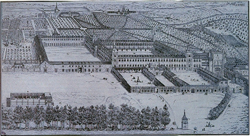
It was located in the Palacio del Buen Retiro in Madrid until May 1808.
From 1820, when teaching was resumed, until 1847 it was located in the Aduana Vieja in the Plaza de la Leña and later in the Conservatory of Arts in Turco Street. At the beginning of the academic year 1889-90, students and professors continued their activity in the new building in Alfonso XII Street, where the School remained until it moved to its current location in the Ciudad Universitaria in Madrid.
A Royal Decree created the Special School of Forestry Engineering in 1835, although it did not start its activity until 1848 in Villaviciosa de Odón, Madrid. The first graduates of the School of Villaviciosa created the Body of Forestry Engineers.


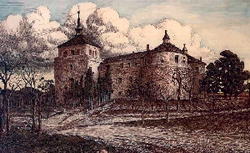
In 1870 it was relocated to the Real Sitio de San Lorenzo de El Escorial, where it remained until 1914 when was transferred to Madrid, first to Rey Francisco Street and then to General Martinez Campos Street. Its current premises are in the Ciudad Universitaria in Madrid.
The industrial engineers' lectures descend from the Patriotic Seminar of Vergara and the activities of the Economic Associations of Friends of the Country. José I in Madrid opened the Arts Conservatory, an imitation of the one in Paris, in 1809. It was created with the intention to give place to stable education but did not even last a year. The Royal Decree (18.08.1842) reopened it with the same name but within a short period of time it was again shut down. It seems that it was preferable to provide students with grants and send them for training abroad. The Minister of Trade, Seijas Lozano, signed a Royal Decree (4.10.1850) in order to create the Royal Industrial Institute and the degree in Industrial Engineering. The institute also had to suffer several moves and incomprehensible political ups and downs. In 1875 the Central School was established and ten years later it was closed along with the Royal Institute. The Higher School was reopened in 1901 and has continued its activities until nowadays.

The Minister of Public Works, Manuel Alonso Martínez, founded the Central Agriculture School on 01 October 1855. At first it was set up on the "La Flamenca" estate on the Royal Property in Aranjuez. It was closed on 3 November 1868 and by another Decree (28.01.1869) immediately moved to Madrid. Ratified by several legal norms, it was given the so-called "La Florida" or "La Moncloa" property, the present University Campus of Madrid, as well as other nearby land. The new building of the Agricultural Institute of Alfonso XII was constructed on the property. Later it was called National Agronomy Institute and today Higher Technical School of Agricultural Engineering of Madrid.
The General School of Telegraphy was the first of the three Higher Schools to be created in the 20th century. It was founded by a Decree (3.06.1913) with three sections and another Decree (22.04.1920) created the qualification of Telecommunication Engineer. From 1912 to 1935 it was located in a building on Paseo de Recoletos in Madrid, until 1936 on Ferraz Street, then on Conde de Peñalver Street until it was finally transferred to the Ciudad Universitaria in Madrid.
In 1926 and 1928 the qualification of Aeronautical Engineer and the Higher School of Aeronautical Engineering, located near the airfield of Cuatro Vientos in Madrid, were created almost simultaneously. The Military Academy of Aeronautical Engineering was set up by a Decree (15.10.1939) and by another recovered its civil character. The Technical Education Organisation Law (20.07.1957) provided it with its current name of Higher Technical School of Aeronautical Engineering. It was established in a modern building in the Ciudad Universitaria in Madrid.
The newest of the centres is the Faculty of Computer Sciences. Madrid's Institute of Computer Sciences was created in 1969 outside the university framework until the studies in 1976 became part of the University and simultaneously the Faculty of Computer Sciences was set up. From the first day of lectures in October 1977, it was integrated into the UPM. Since 1988 it has been located on the campus of Montegancedo.

Since 14 September 1998 the Faculty of Physical Activity and Sport Sciences (INEF) was an affiliated centre and on 1 October 2003 was integrated to our University.
The University Schools of Technical Engineering were mainly set up at the same time as the Higher Technical Schools to provide training for Assistants or Technicians. However, these names gradually disappeared and gave way to the present names and qualifications. In the brief summary below the dates of their creation and some additional information is given with the intention not to repeat the already said.
The Body of Architect Technician was set up by the Royal Decree (24.01.1855) and its studies by another on 20.09.1881. The training of Technicians in the Schools of Arts and Industries began by a Royal Order (20.08.1895). In 1924 these studies came under the supervision of the Higher Technical Schools (R.O. 11.09.1924) until a Decree (10.08.1955) founded the Schools of Architect Technicians although they became fully independent only in July 1962.
By the previously mentioned Decree (1.09.1855) the School of Agricultural Engineers and the School of Agricultural Technicians were created. The first course of technical studies was held in Madrid and the remaining, the ones of the technological section or of the technicians, were held on the "La Flamenca" estate in Aranjuez.
The Special School of Public Works Assistants was created to "provide suitable training to those that in a future aspire to enter as employees in the Public Works department", according to the Royal Decree (4.02.1857). The centre remained closed from 1868 to 1910.
The present University School of Technical Industrial Engineering of Madrid was known under the following names: School of Industrial Arts, Industrial School of Madrid, Higher School of Work, School of Industrial Technicians and School of Technical Industrial Engineering. It was located in different buildings and its existence can be traced back to the late 19th century.
The University School of Technical Topographical Engineering was founded by a Decree (24.09.1954) that made it dependent on the Ministry of Education. In Spain professional studies in Topography date back to 1870 when the Geographical and Cadastral Institute was created that, for many years, provided training for professionals.
The Technical Education Organisation Law (20.07.1957) presented the basis for the creation of the Technical School of Forestry Technicians that as a result of the subsequent Technical Education Re-organisation Law (29.09.1964) was called University School of Technical Forestry Engineering.
The studies of Telecommunication Assistants and its two specialisation options were established by the Decree (13.01.1946) although the General School of Telegraphy had been created previously by Royal Decree (3.11.1913) divided into three sections: elementary, preparation for the Body of Telegraphers and higher studies.
The School of Aeronautical Engineering Assistants was set up by a Decree (21.08.1956) and the Law in 1957 changed its name to Technical School for Aeronautical Technicians.

The University School of Computer Sciences of Madrid was established on 27 October 1978 and from the beginning has formed part of the UPM.
The Polytechnic School of Higher Education (EPES) has its origin in Decree 23/1997 of 20 February. The Governing Council of the Community of Madrid authorised the creation of the School for the academic year 1996/97. It provided training for the second cycle qualifications of Geodesy and Cartography Engineer and Material Engineer. The degree in Environmental Sciences was authorised by the Decree 78/1997 on 26 June.
Two of the qualifications Geodesy and Cartography Engineer and Engineer in Environmental Sciences have their head office in the National Institute of Physical Education (INEF). The qualification Material Engineer is located in the Higher Technical School of Civil Engineering.
Besides the previously mentioned centres, others have formed part of the UPM but have been transferred to other universities, as for example the University School of Technical Agronomists of Ciudad Real, the Technical University School of Almadén, the University School of Alcalá de Henares and the University School of Villava.
The UPM has several research institutes: the Juan Herrera Institute, the José Antonio de Artigas Industrial Research Institute, the Solar Energy Institute, the Automobile Research Institute, the Automatic Control Institute, the Agustín Bethencourt Institute-Foundation, the Institute of Optielectronics and Microtechnology.
The UPM also includes the following affiliated centres: the CEU for studies in architecture, the Higher Centre for Fashion Design and the Higher School for Brewing. In the academic year 1972-73 the Institute of Educational Science was also attached to the UPM.